
UPCOMING TNAPT EVENTS
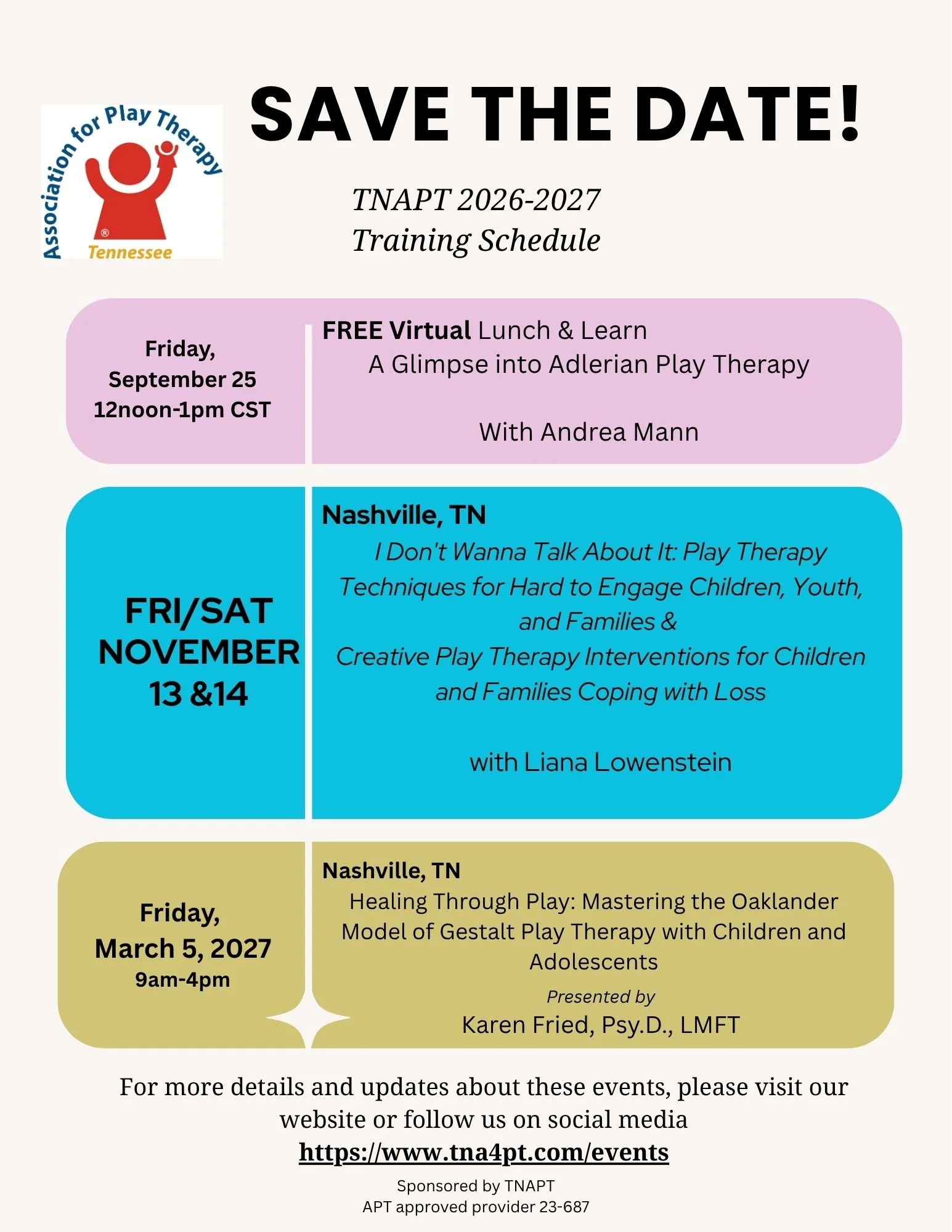
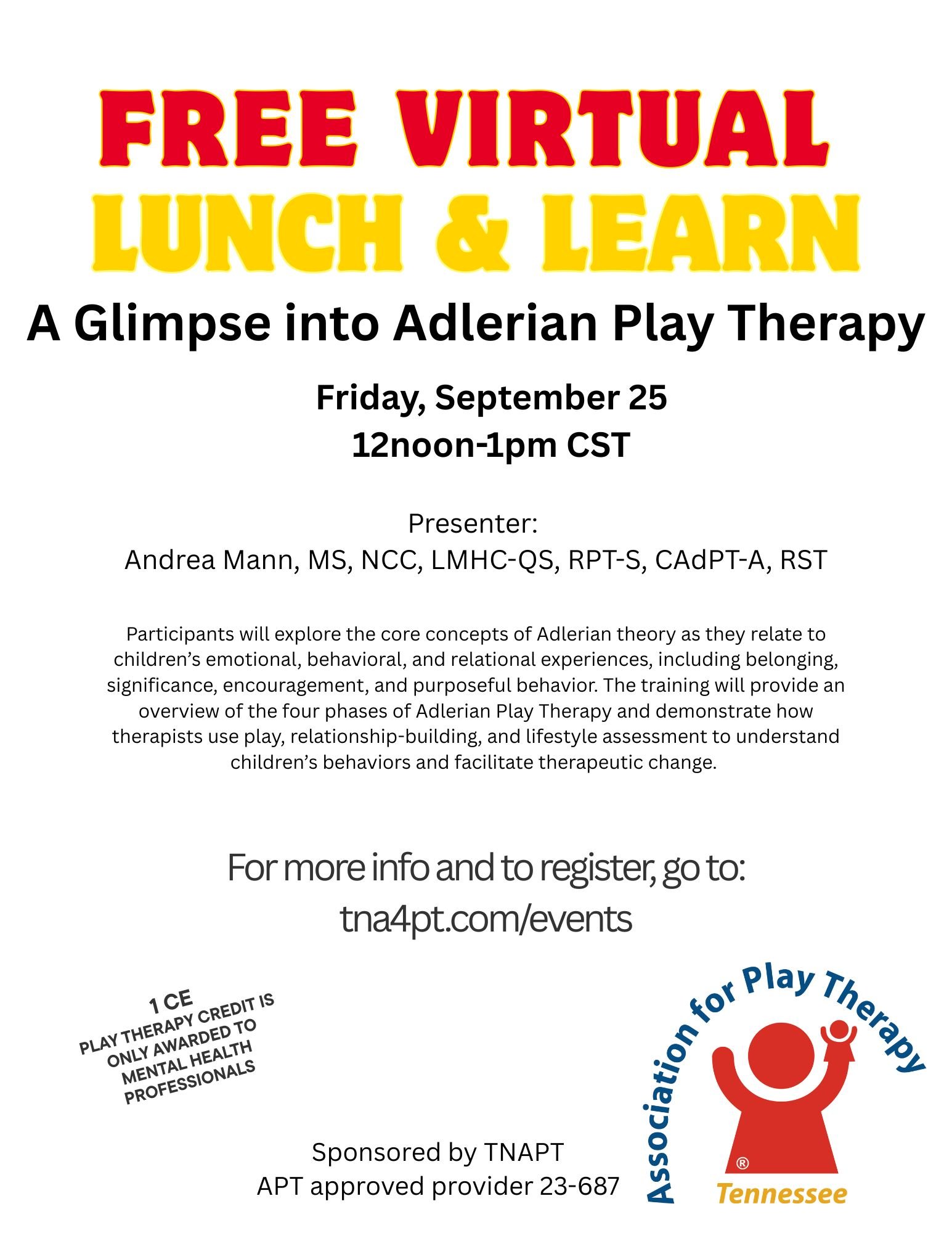
Presenter: Andrea Mann, MS, NCC, LMHC-QS, RPT-S, CAdPT-A, RST
This lunch-and-learn style training introduces mental health professionals to the foundational principles and clinical application of Adlerian Play Therapy (AdPT). Participants will explore the core concepts of Adlerian theory as they relate to children’s emotional, behavioral, and relational experiences, including belonging, significance, encouragement, and purposeful behavior. The training will provide an overview of the four phases of Adlerian Play Therapy and demonstrate how therapists use play, relationship-building, and lifestyle assessment to understand children’s behaviors and facilitate therapeutic change. Through didactic instruction and case-based discussion, participants will gain exposure to practical Adlerian play therapy concepts and interventions that can be integrated into clinical practice with children and families.
Learning Objectives
By the end of this training, participants will be able to:
Identify at least three foundational concepts of Adlerian Play Therapy and describe how they influence play therapy treatment with children.
Describe the four phases of Adlerian Play Therapy and the role of the therapist within each phase of treatment.
Demonstrate understanding of how Adlerian Play Therapy conceptualizes children’s behavior through the use of encouragement, relationship-building, and lifestyle assessment strategies.
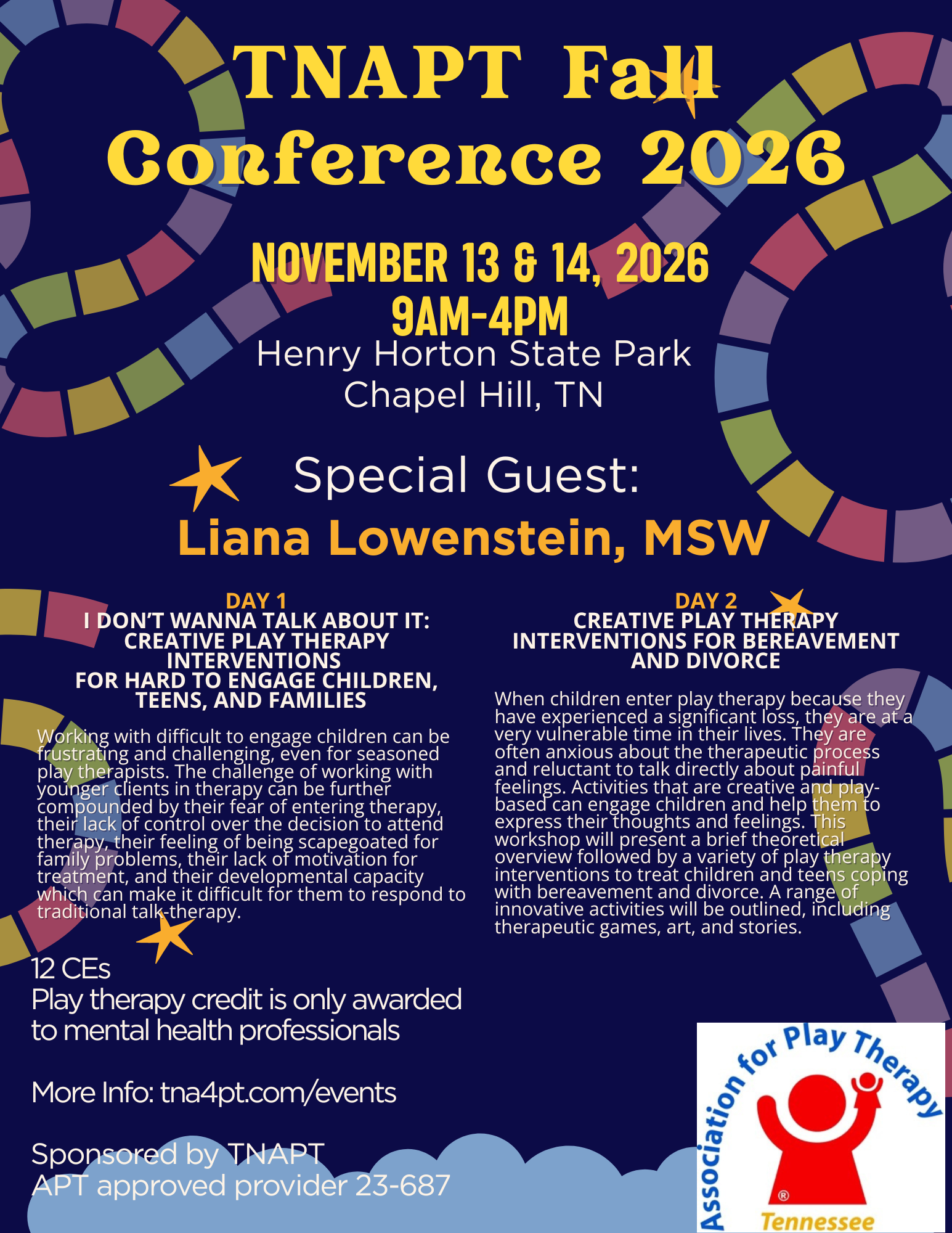
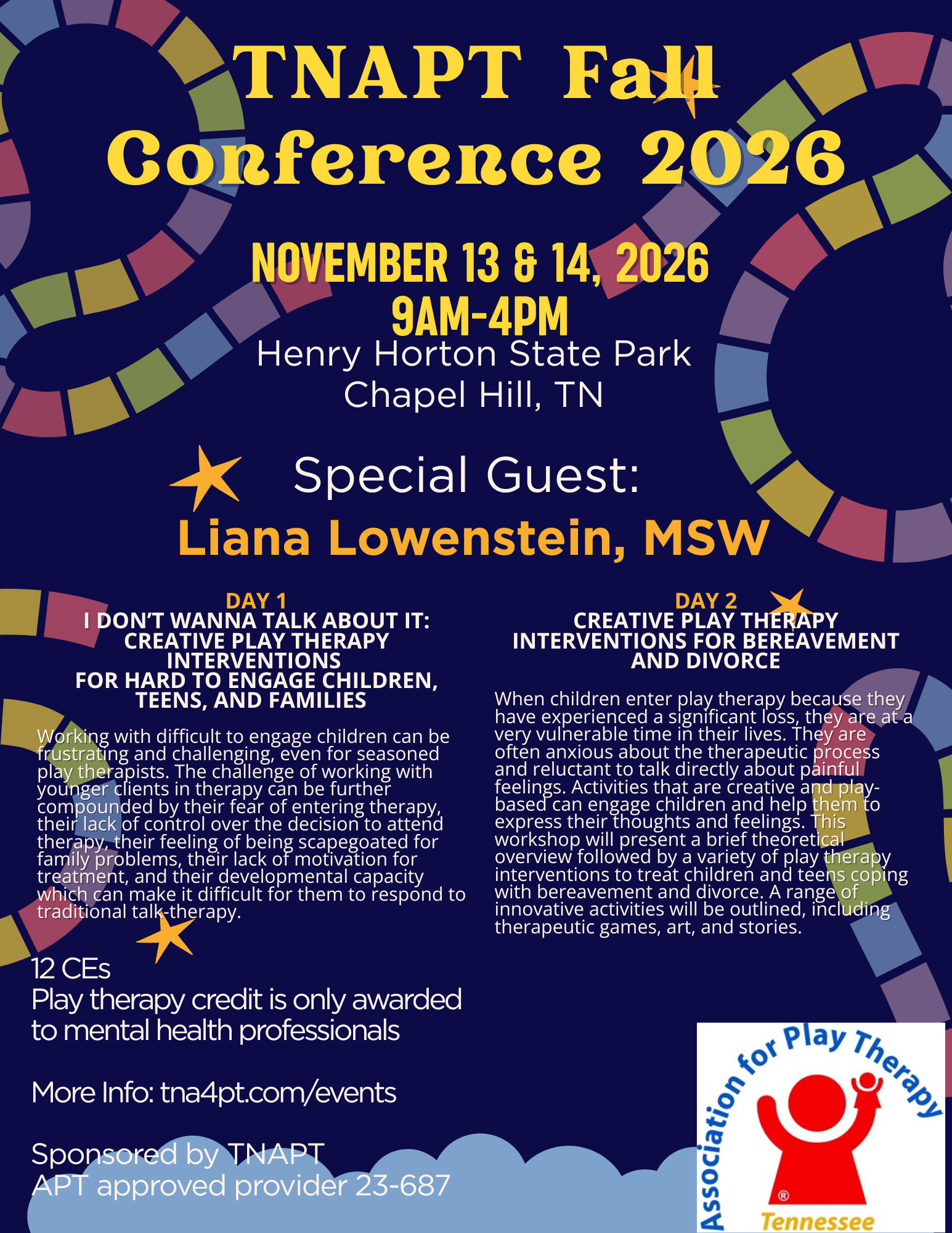
November 13-14, 2026
9am-4pm
**Cost includes lunch each day
Henry Horton State Park, Chapel Hill, TN
Special Guest- Liana Lowenstein, MSW
Day 1
I Don’t Wanna Talk About It: Creative Play Therapy Interventions For Hard to Engage Children, Teens, and Families
Working with difficult to engage children can be frustrating and challenging, even for seasoned play therapists. The challenge of working with younger clients in therapy can be further compounded by their fear of entering therapy, their lack of control over the decision to attend therapy, their feeling of being scapegoated for family problems, their lack of motivation for treatment, and their developmental capacity which can make it difficult for them to respond to traditional talk-therapy.
The first step in working with hard to engage children is understanding the reasons underlying their reluctance to open-up. The second step involves engaging children in the therapeutic process.
The presenter will outline various factors that underlie therapeutic reluctance. Interventions will be presented to engage children in play therapy and to maximize potential for change. Emphasis will be on play therapy techniques including games, art, and stories.
The techniques will be applied to specific clinical examples to illustrate how they can build rapport, facilitate open communication, and help the child work through treatment goals.
Learning Objectives:
Describe the factors underlying therapeutic resistance.
Implement creative play therapy interventions to establish rapport-building with children of all ages.
Describe creative play therapy interventions to facilitate goal setting.
Utilize innovative strategies to engage resistant, hard to serve parents.
Implement play therapy techniques with clients who are reluctant to verbally articulate their thoughts and feelings.
Utilize activities to engage families in play therapy sessions.
Day 2
Creative Play Therapy Interventions for Bereavement and Divorce
When children enter play therapy because they have experienced a significant loss, they are at a very vulnerable time in their lives. They are often anxious about the therapeutic process and reluctant to talk directly about painful feelings. Activities that are creative and play-based can engage children and help them to express their thoughts and feelings. This workshop will present a brief theoretical overview followed by a variety of play therapy interventions to treat children and teens coping with bereavement and divorce. A range of innovative activities will be outlined, including therapeutic games, art, and stories.
Learning Objectives:
Define grief, traumatic grief, and disenfranchised grief.
Articulate the continuum of parent-child relationships after separation and divorce.
Implement creative play therapy assessment interventions
Describe strategies to maintain neutrality when working with high-conflict divorce cases.
Apply at least 5 new interventions in sessions with children and families coping with bereavement and divorce.
Describe the unique areas to address when working with children impacted by suicide, murder, and substance-related death.
12 CEs, Play therapy credit is only awarded to mental health professionals
Sponsored by TNAPT
APT approved provider 23-687
November 13-14, 2026
9am-4pm
Cost includes lunch each day**
Henry Horton State Park, Chapel Hill, TN
Special Guest- Liana Lowenstein, MSW
Day 1
I Don’t Wanna Talk About It: Creative Play Therapy Interventions For Hard to Engage Children, Teens, and Families
Working with difficult to engage children can be frustrating and challenging, even for seasoned play therapists. The challenge of working with younger clients in therapy can be further compounded by their fear of entering therapy, their lack of control over the decision to attend therapy, their feeling of being scapegoated for family problems, their lack of motivation for treatment, and their developmental capacity which can make it difficult for them to respond to traditional talk-therapy.
The first step in working with hard to engage children is understanding the reasons underlying their reluctance to open-up. The second step involves engaging children in the therapeutic process.
The presenter will outline various factors that underlie therapeutic reluctance. Interventions will be presented to engage children in play therapy and to maximize potential for change. Emphasis will be on play therapy techniques including games, art, and stories.
The techniques will be applied to specific clinical examples to illustrate how they can build rapport, facilitate open communication, and help the child work through treatment goals.
Learning Objectives:
Describe the factors underlying therapeutic resistance.
Implement creative play therapy interventions to establish rapport-building with children of all ages.
Describe creative play therapy interventions to facilitate goal setting.
Utilize innovative strategies to engage resistant, hard to serve parents.
Implement play therapy techniques with clients who are reluctant to verbally articulate their thoughts and feelings.
Utilize activities to engage families in play therapy sessions.
Day 2
Creative Play Therapy Interventions for Bereavement and Divorce
When children enter play therapy because they have experienced a significant loss, they are at a very vulnerable time in their lives. They are often anxious about the therapeutic process and reluctant to talk directly about painful feelings. Activities that are creative and play-based can engage children and help them to express their thoughts and feelings. This workshop will present a brief theoretical overview followed by a variety of play therapy interventions to treat children and teens coping with bereavement and divorce. A range of innovative activities will be outlined, including therapeutic games, art, and stories.
Learning Objectives:
Define grief, traumatic grief, and disenfranchised grief.
Articulate the continuum of parent-child relationships after separation and divorce.
Implement creative play therapy assessment interventions
Describe strategies to maintain neutrality when working with high-conflict divorce cases.
Apply at least 5 new interventions in sessions with children and families coping with bereavement and divorce.
Describe the unique areas to address when working with children impacted by suicide, murder, and substance-related death.
12 CEs, Play therapy credit is only awarded to mental health professionals
Sponsored by TNAPT
APT approved provider 23-687

Healing Through Play: Mastering the Oaklander Model of Gestalt Play
Therapy with Children and Adolescents
Karen Fried, Psy.D., LMFT
Friday, March 5, 2027
9am-4pm
Junior League of Nashville
2202 Crestmoor Road, Nashville, Tennessee 37215
This advanced, experiential training equips mental health professionals with the theoretical
framework and practical tools of the Oaklander Model of Gestalt Play Therapy. Rooted in the
therapeutic philosophy of Dr. Violet Oaklander, this course explores how to foster a strong sense
of self and enhance contact functions in younger clients through creative, multi-media
approaches. Participants will dive deep into the therapeutic process, focusing heavily on the
vital I/Thou relationship and Peter Mortola’s four-part process for play therapy exercises.
Moving beyond early childhood, the training explicitly addresses the unique developmental
landscape of adolescence. Common myths regarding teenagers will be addressed, offering
instead a clear look into executive functioning challenges, at-risk behaviors, and the dynamics
of bullying. Through a blend of theoretical analysis and hands-on technique demonstrations,
attendees will learn how to use play therapy to engage even resistant adolescents, recognize
signs of distress, and support them through critical developmental milestones.
Learning Objectives
By the conclusion of this training, participants will be able to:
● Explain the core concepts of Gestalt Therapy and their specific application to children
and adolescents via the Oaklander Model of Gestalt Play Therapy.
● Utilize multiple media modalities to help young clients develop a strong sense of self, a
foundational tenet of the Oaklander Model.
● Describe the concept of the I/Thou relationship and analyze its critical role within the
play therapy process.
● Apply childhood developmental concepts to the therapeutic process, demonstrating how
the Oaklander Model directly addresses these milestones.
● Implement Peter Mortola’s four-part process across various play therapy exercises.
● Analyze how contact functions allow children to achieve an improved sense of self
through experiential learning.
● Demonstrate specific Oaklander play therapy techniques designed to strengthen a
child's contact functions.
● Outline the definitive stages of the Oaklander Model therapeutic process and their
practical application.
● Deconstruct common myths regarding adolescents and explain how play therapy meets
their developmental needs in an engaging manner.
● Identify the underlying reasons driving adolescent at-risk behaviors and apply play
therapy strategies to effectively engage this population.
● Analyze demographic data regarding the adolescents most vulnerable to bullying and
formulate play therapy approaches to manage the resulting trauma.
● Identify the behavioral and emotional signs of adolescent bullying using targeted play
therapy assessment techniques.
● Describe executive functioning challenges in adolescence and demonstrate how play
therapy techniques can be used to address these deficits.

Healing Through Play: Mastering the Oaklander Model of Gestalt Play
Therapy with Children and Adolescents
Karen Fried, Psy.D., LMFT
Friday, March 5, 2027
9am-4pm
Junior League of Nashville
2202 Crestmoor Road, Nashville, Tennessee 37215
This advanced, experiential training equips mental health professionals with the theoretical
framework and practical tools of the Oaklander Model of Gestalt Play Therapy. Rooted in the
therapeutic philosophy of Dr. Violet Oaklander, this course explores how to foster a strong sense
of self and enhance contact functions in younger clients through creative, multi-media
approaches. Participants will dive deep into the therapeutic process, focusing heavily on the
vital I/Thou relationship and Peter Mortola’s four-part process for play therapy exercises.
Moving beyond early childhood, the training explicitly addresses the unique developmental
landscape of adolescence. Common myths regarding teenagers will be addressed, offering
instead a clear look into executive functioning challenges, at-risk behaviors, and the dynamics
of bullying. Through a blend of theoretical analysis and hands-on technique demonstrations,
attendees will learn how to use play therapy to engage even resistant adolescents, recognize
signs of distress, and support them through critical developmental milestones.
Learning Objectives
By the conclusion of this training, participants will be able to:
● Explain the core concepts of Gestalt Therapy and their specific application to children
and adolescents via the Oaklander Model of Gestalt Play Therapy.
● Utilize multiple media modalities to help young clients develop a strong sense of self, a
foundational tenet of the Oaklander Model.
● Describe the concept of the I/Thou relationship and analyze its critical role within the
play therapy process.
● Apply childhood developmental concepts to the therapeutic process, demonstrating how
the Oaklander Model directly addresses these milestones.
● Implement Peter Mortola’s four-part process across various play therapy exercises.
● Analyze how contact functions allow children to achieve an improved sense of self
through experiential learning.
● Demonstrate specific Oaklander play therapy techniques designed to strengthen a
child's contact functions.
● Outline the definitive stages of the Oaklander Model therapeutic process and their
practical application.
● Deconstruct common myths regarding adolescents and explain how play therapy meets
their developmental needs in an engaging manner.
● Identify the underlying reasons driving adolescent at-risk behaviors and apply play
therapy strategies to effectively engage this population.
● Analyze demographic data regarding the adolescents most vulnerable to bullying and
formulate play therapy approaches to manage the resulting trauma.
● Identify the behavioral and emotional signs of adolescent bullying using targeted play
therapy assessment techniques.
● Describe executive functioning challenges in adolescence and demonstrate how play
therapy techniques can be used to address these deficits.
"TNAPT Approved Provider No. 23-687.
Registrants are advised to review our cancellation and refund policy, available below, prior to registering for any TNAPT training."
MARK YOUR CALENDARS
UPCOMING TNAPT EVENTS
TNAPT Cancellation Refund Policy:
The Tennessee Association for Play Therapy (TNAPT) provides two types of play therapy training: live (in-person or real-time virtual) and online. Below is a concise overview of their cancellation and refund policies:
General Policies: Minimum Enrollment: A TNAPT Training requires a minimum number of participants—10 for online sessions and 40 for live events. TNAPT may cancel sessions not meeting these thresholds. Cancellation by TNAPT: If TNAPT cancels a training due to low enrollment, weather emergencies, or technical issues, registrants can choose to attend a rescheduled session at no extra cost or receive a full refund within one week. Attendance Requirements: Full attendance is mandatory for CE credit. Partial credit is not awarded.
Eligibility for Play Therapy Credit: Only mental health professionals, as defined by the Association for Play Therapy (APT), are eligible to receive play therapy credits. Record Retention: Post-test answers and participant information are stored for audit purposes for five years.Refund Exceptions: No refunds are issued for courses where a certificate has already been granted.
Live Trainings Without a Registration Fee:
Educational Purpose: These sessions are free and intended for educational purposes. Credit for TNAPT Members: TNAPT members may receive play therapy credits as a membership benefit. Certificate Fees: Participants may obtain a certificate for play therapy contact hours by paying the fee specified in the training announcement. Assessment Requirement: Attendees must pass a post-event assessment before receiving a certificate.
Live Trainings With a Registration Fee:
Cancellation/Refund Policy:
Cancellations made at least 7 days before the scheduled training are eligible for a full refund.
Cancellations made less than 7 days before the training are not eligible for a refund or credit.
No-Shows: Participants who do not attend the training will not receive a refund or credit.
For further details or inquiries, please contact TNAPT at TNA4PT@gmail.com

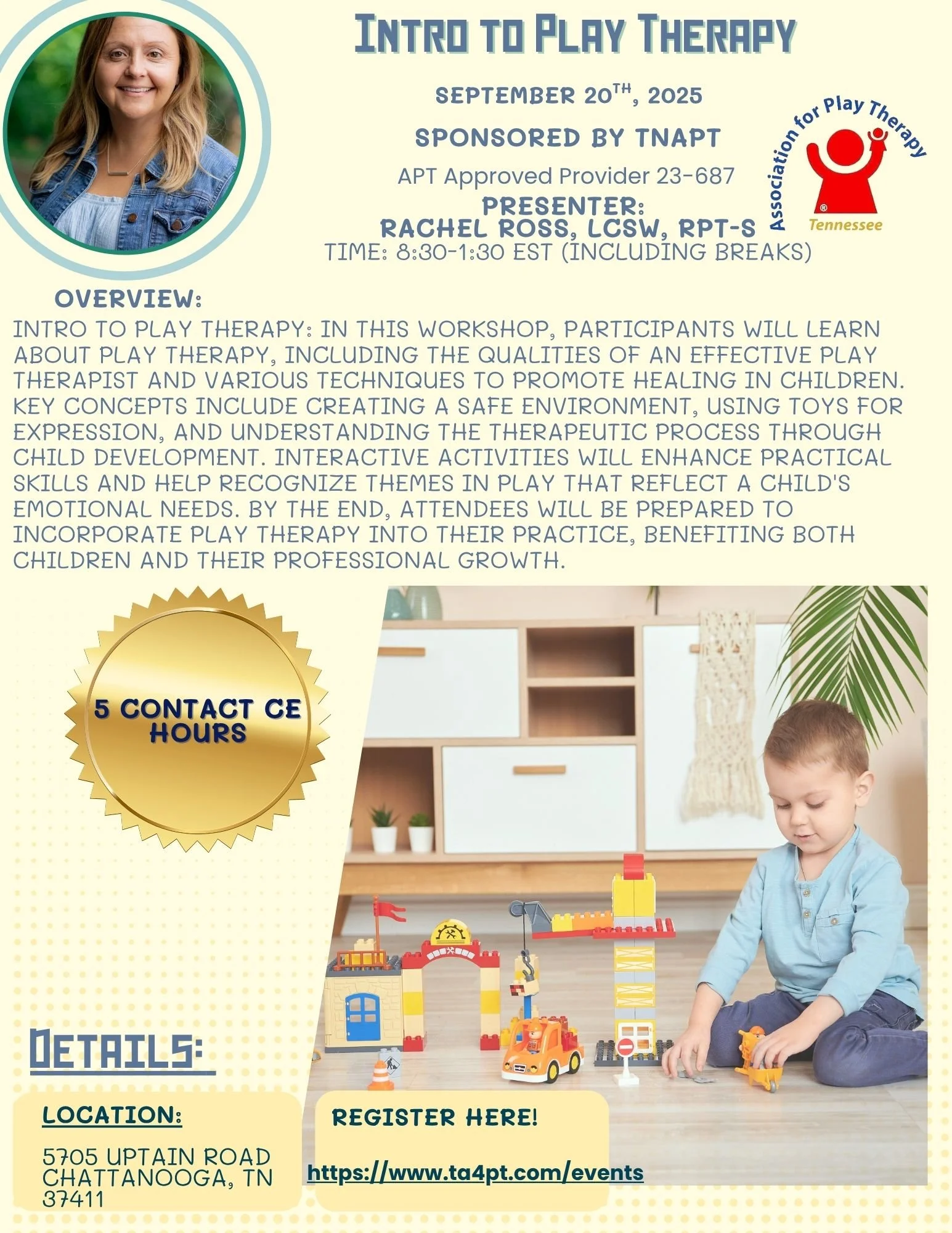
Child Centered Play Therapy 101
In this workshop, participants will learn about Play Therapy, including the qualities of an effective Play Therapist and various techniques to promote healing in children. Key concepts include creating a safe environment, using toys for expression, and understanding the therapeutic process through child development. Interactive activities will enhance practical skills and help recognize themes in play that reflect a child's emotional needs. By the end, attendees will be prepared to incorporate Play Therapy into their practice, benefiting both children and their professional growth.
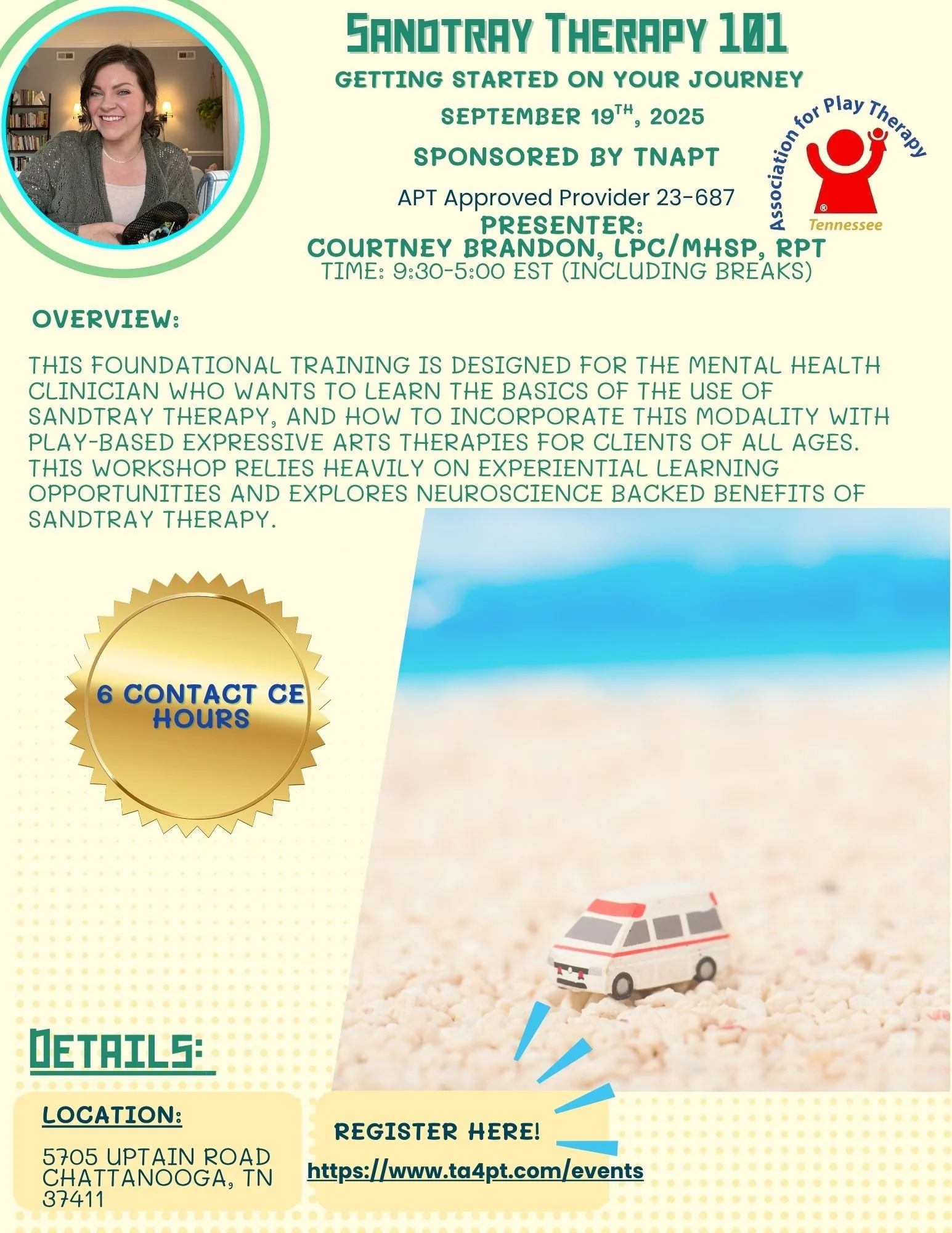
Sandtray Therapy 101
This foundational training is designed for the mental health clinician who wants to learn the basics of the use of sand tray therapy in their play therapy work, and how to incorporate this modality with play-based expressive arts therapies for clients of all ages. This workshop will rely heavily on experiential opportunities as lived experience is the best way to learn and get a felt sense of the magic of expressing oneself through the use of sand and miniatures via play therapy techniques. As such, participants may choose to bring 10-15 of their own miniatures, but this is not required.
This event will be capped at 24 participants to allow for in-depth exploration and discussion of the topic. There will be several experiential play therapy opportunities to implement and process directives that can be used with a variety of client ages and presenting concerns.


TNAPT 2025-2026 Training Calendar
TNAPT has 36 hours of continuing education planned across the state in 2025-2026! We are looking forward to some amazing opportunities for learning and connection with fellow play therapists and those pursuing their RPT™ certification.
Stay tuned to our website and social media pages for more info as we get closer to each training date.
APT International Play Therapy Week 2025
Stay tuned to our social media pages and your in-box for ways TNAPT will be celebrating International Play Therapy Week 2025!
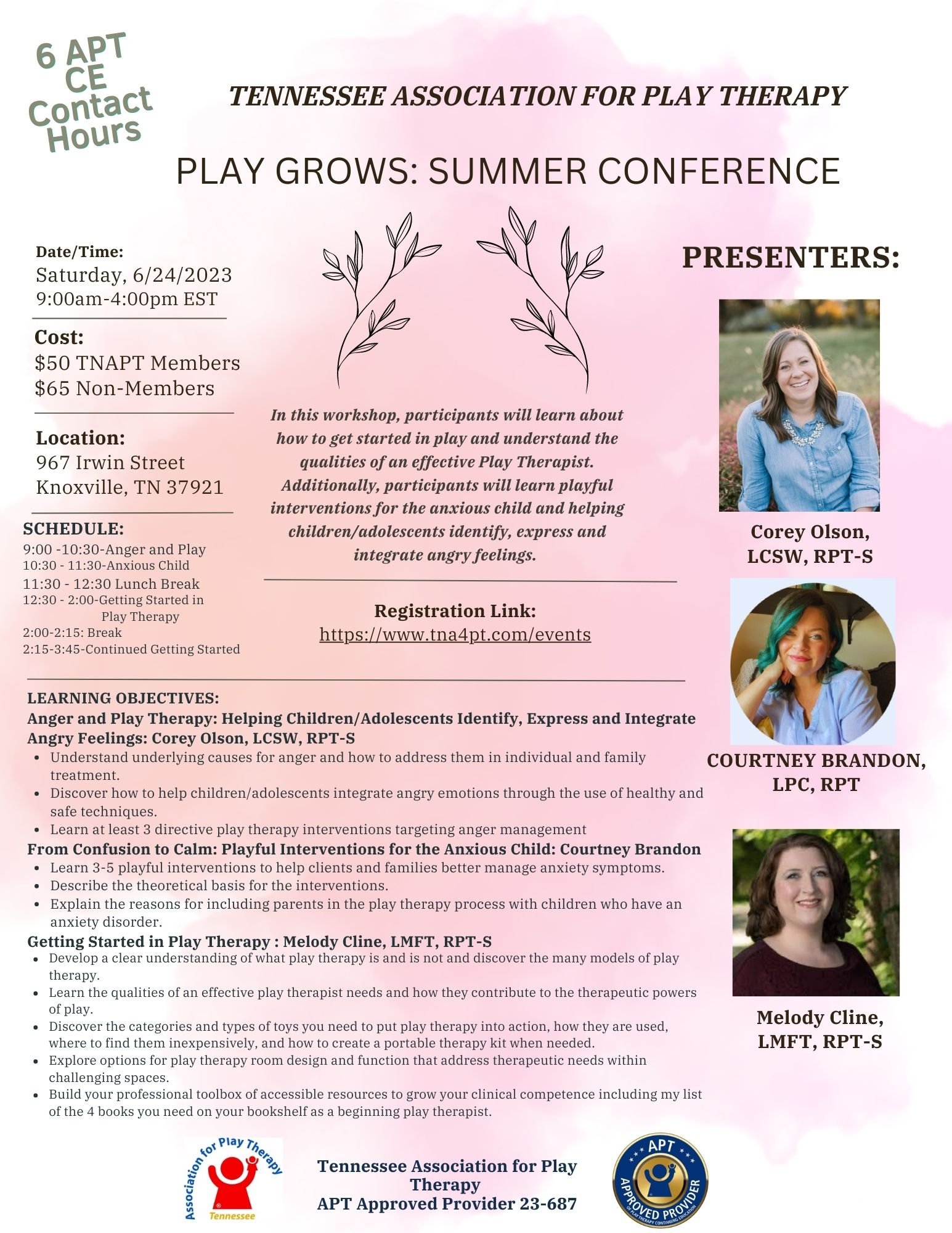


Love Blooms Workshop
About the Program:
In this workshop, participants will learn how to identify and recognize the characteristics of traumatic grief in children and their caregivers. This workshop includes a focus on the relationship between children and their caregivers as well as the relationship between the family and the therapist. Participants will be introduced to the GREEN care and ATTEND models and learn how to integrate both with play therapy theories. Participants will leave with a variety of play therapy interventions designed to facilitate post-traumatic growth related to traumatic grief.
Date/Time:
Friday June 23rd,
2023
9:30am-4:30pm EST
Cost:
$140.00 TNAPT Members $155.00 Non-Members Lunch Provided
Location:
University of Tennessee: College of Veterinary Medicine
2407 River Dr, Knoxville, TN 37996
Learning Center Classroom